

Recent Publications:

Quote of the Week:
The price of any commodity tends to gravitate toward the production cost. If the price is below cost, then production slows down. If the price is above cost, profit can be made by generating and selling more. At the same time, the increased production would increase the difficulty, pushing the cost of generating towards the price.
In later years, when new coin generation is a small percentage of the existing supply, market price will dictate the cost of production more than the other way around.
- Satoshi Nakamoto on February 21, 2010 via The Book of Satoshi by Phil Champagne
The Latest:
Bitcoin production costs up 9% on higher hashrate, energy prices1
Summary: The estimated median cost of mining a single bitcoin climbed above $70,000 in the Q2 2025 (April 1 - June 30).
Q1 2025 (January 1 - March 30) to Q2 2025: ~9% increase in median cost.
Bitcoin price is currently up ~25% since April 1st.
Q4 2024 (October 1 - December 31) to Q1 2025: ~23% increase in median cost.
Bitcoin price decreased ~12% from December 31st, 2024 to March 31st, 2025.
Impact: Bitcoin miners depend on the spread between bitcoin price and cost of mining to stay profitable. Increasing bitcoin mining difficulty paired with increasing electricity costs in the summer due to greater demand for cooling will keep the cost of mining high. Tariffs on Chinese-imported bitcoin mining machines also increase direct costs to bitcoin mining companies. However, the cost of mining machines is not included in the average cost of mining calculation.
See The Signal below for more on the Chinese-imported bitcoin mining machines.
See The Chart below for more on the relationship between bitcoin price and average mining costs.
Key metrics continue to stack in Bitcoin’s favor
Summary:
Bitcoin hasn’t traded below $100,000 since May 8th (43 days)
“The total number of known publicly traded holders (of bitcoin on their balance sheet as a treasury asset) has increased to 129”2. The total is 235 including private companies and sovereign entities. “That’s an increase of 27 entities in just 30 days.”
Traders use technical indicators such as MACD (Moving Average Convergence Divergence) for buy/sell opportunities. “The MACD has now flipped positive, indicating a renewed widening of spread or volatility boom ahead.”3
Impact:
Holding the psychological barrier above $100,000 for an extended period is impressive. This indicates stability in an otherwise unpredictable environment.
Companies and countries putting bitcoin on their balance sheets drives widespread adoption.
Some consider technical indicators such as MACD hocus-pocus. Volatility can be bullish or bearish, but “previous positive crossovers of the MACD presaged major bull runs.” I prefer good hocus-pocus to bad hocus-pocus.
BlackRock Bitcoin ETF IBIT 0.00%↑ reached 8 straight days of inflows4
Summary: Capital continues to pile into bitcoin products. “More than $46.3 billion has flowed into the 11 bitcoin products, led by BlackRock’s IBIT” in since inception.
Impact: ETF flows and bitcoin price continue their (loose) correlation. Bitcoin ETF’s do strengthen the Bitcoin network even though owning actual bitcoin is superior. To quote BTCurrent Weekly v1 released last week, IBIT does offer bitcoin exposure in traditional investment vehicles where actual bitcoin can’t be purchased.
Project Eleven raised $6 million to help secure bitcoin from quantum computing threats5
Summary: “Project Eleven CEO Alex Pruden said the funding will allow the company to build “the tools, standards and ecosystem required to ensure digital assets remain secure in a post-quantum world.”” Over 30% of bitcoin addresses are not sufficiently secure and this puts “a total of 6,262,905 BTC — worth about $648 billion — at risk of a potential quantum attack.”
Impact: Quantum computing is one of the few major risks to the Bitcoin network. Quantum computers are not near the level needed to threaten Bitcoin’s cryptography and “most estimates do not see quantum computing as a threat to the cryptography used in Bitcoin until the 2030s at the earliest.”6 However, it’s always worth building solutions to potential problems.
The Signal: Chinese bitcoin mining machine makers set up US production
Bitmain, Canaan and MicroBT are Chinese-based bitcoin mining machine makers setting up shop in the United States to avoid tariffs. These three companies build “over 90% of global mining rigs”7 and “Chinese exports currently have 30% tariffs heading into the U.S., while the rest of the world has a baseline of 10%.”8
Bitmain: Set up U.S. production of mining rigs in December following Trump's presidential win in November.
Canaan: Began trial production in the U.S. in April with the aim of avoiding tariffs. The initiative is exploratory as the volatile tariff situation prevents heavy investment.
MicroBT: Actively implementing a localization strategy in the U.S. to avoid the impact of tariffs.
Of the other 10% of mining machine makers, Aurandine is a US-based company backed by MARA 0.00%↑, the largest bitcoin miner by market cap. "While over 30% of global bitcoin mining occurs in North America, more than 90% of mining hardware originates from China representing a major imbalance of geographic demand and supply," said Auradine's chief strategy officer, Sanjay Gupta.
The three largest bitcoin miners are all U.S.-based. Other than electricity, bitcoin mining machines are one of the major expenses to bitcoin mining companies. In the short-term, U.S. bitcoin miners must decide whether to purchase the cheaper Chinese bitcoin mining machines with tariffs or purchase U.S.-produced bitcoin mining machines.
The U.S.-China trade war continues to put pressure on the already-tight margins of bitcoin mining companies. The tariffs impose structural issues in the Bitcoin supply chain and will only get more severe over time.
U.S.-based bitcoin mining companies should evaluate their mining machine purchase decisions on a few key questions:
How long may the United States tariff Chinese imports?
Assuming no change to the current tariffs, will the U.S. Government allow Chinese bitcoin miner makers to move production to the U.S.? If so, how quickly will they move?
If they are not allowed to move, or not moving fast enough, how long will we continue to purchase Chinese bitcoin mining machines? We will evaluate the cost per mining machine of U.S.-produced vs Chinese-produced + tariffs. And, of course, which machines are the most efficient compared to this adjusted cost.
Expect a shake up on the bitcoin mining machine maker leaderboard. The companies who move quickly and strategically will gain significant leverage.
The Chart: Bitcoin Price vs Average Mining Costs
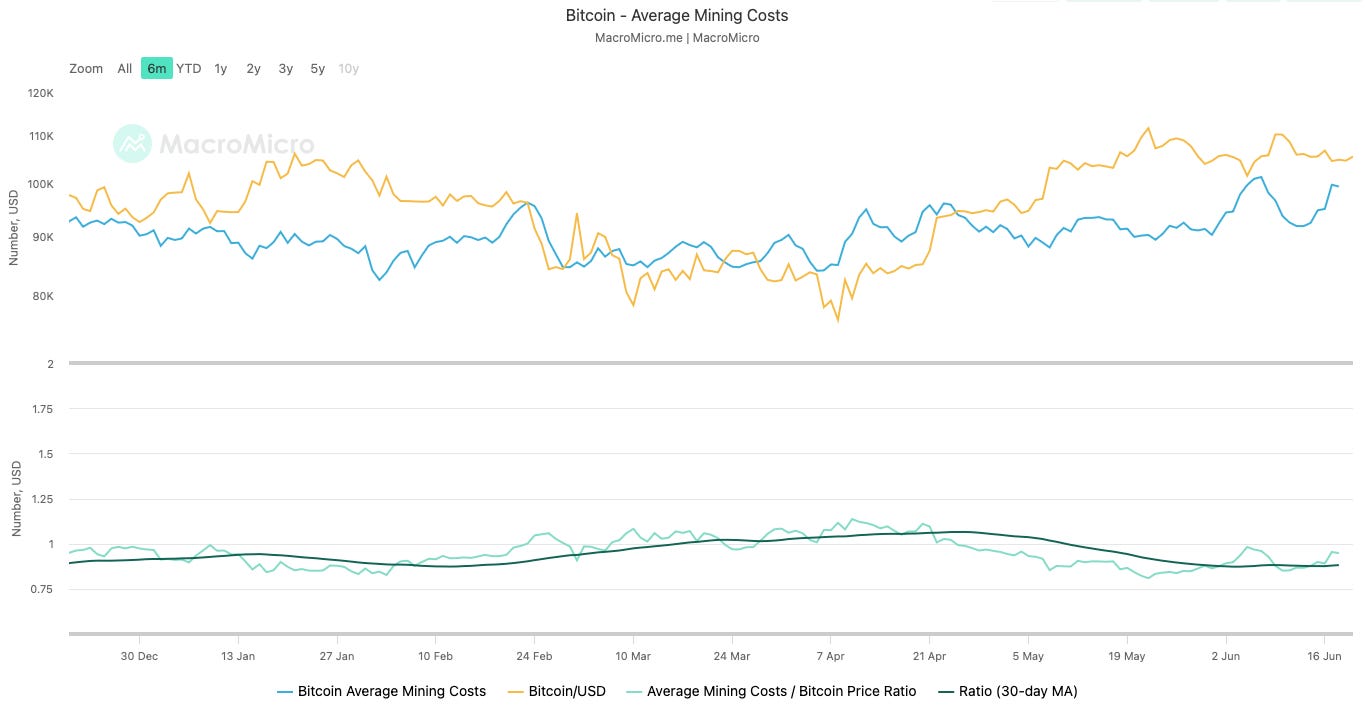
Top Half of The Chart9: The spread between the yellow and blue lines indicate bitcoin miner profitability. When the yellow line is above the blue line, bitcoin miners have the option to sell their mined bitcoin for more than it cost to mine. The more positive the spread, the greater potential profit. Bitcoin miners freeze operations if the spread is negative (blue line above yellow line) for enough time such that they can no longer sustain their mining costs.
Bottom Half: The lower the Average Mining Costs / Bitcoin Price Ratio, the more profitable the bitcoin miners. A ratio above 1 indicates bitcoin miners are unable to sell their mined bitcoin for a profit.
“To calculate the cost of mining one Bitcoin, we need to consider several factors, including the efficiency of the mining hardware (measured in watts per terahash), the hash rate of the mining operation (terahashes per second), and the total energy consumed over the period it takes to mine one Bitcoin.”10
No AI was used in the writing of this newsletter.
Follow @BTCurrent on Nostr and X for additional content.
Donations in sats accepted via Nostr